
Solid Teak vs. Teak Veneer: What High-Net-Worth Buyers Should Check Before Buying
Teak has become one of the most misused words in Indian furniture retail. Walk into most showrooms and you'll see "teak finish," "teak look," and "teak wood" used almost interchangeably — even though they can describe three completely different products at three very different price points.
If you're investing in a piece meant to last decades, here's how to know exactly what you're paying for.
The Core Difference
Solid teak furniture is built entirely from teak wood — the frame, the visible surfaces, the load-bearing joints, all of it. Teak veneer furniture uses a cheaper core material (often plywood or MDF) with a thin sheet of real teak glued to the visible surface. "Teak finish" often means no teak at all — just a stain or laminate designed to look like teak's golden-brown tone.
All three can look nearly identical in a product photo. They do not perform the same way over ten years.
How to Check What You're Actually Buying
Solid teak is dense and genuinely heavy. If a "teak" console table or bench feels surprisingly light for its size, it's very likely veneer over a lighter core material.
On solid teak, the wood grain runs continuously through the thickness of the piece — you can see it on the edges, the underside, the inside of a drawer. On veneer furniture, edges are often finished with a matching strip or laminate that doesn't quite match the grain direction of the top surface. Open a drawer or look underneath — this is where veneer construction is hardest to disguise.
Traditional solid teak furniture uses mortise-and-tenon or dowel joints — wood interlocking with wood. Veneer and lower-grade furniture more often relies on screws, staples, or metal brackets hidden with covers. Turn a piece over (politely, in a showroom) and look at how the legs meet the frame.
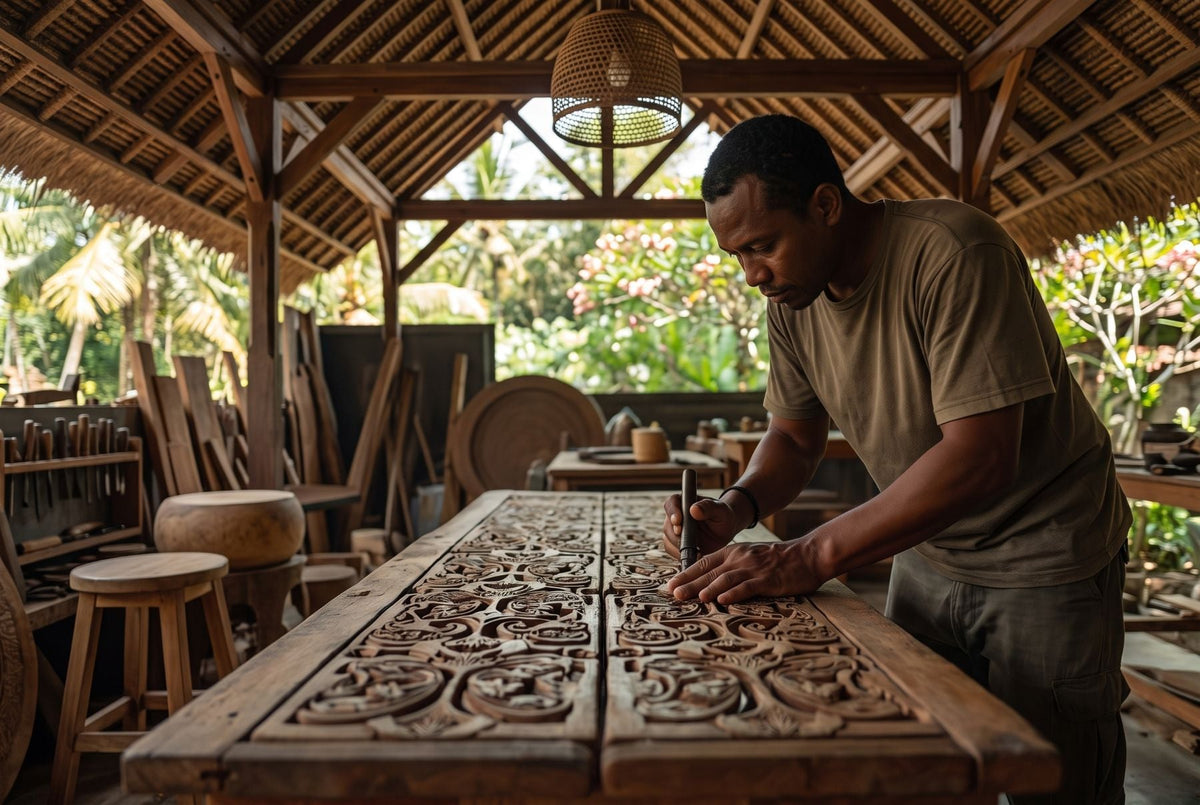
Not all solid teak is equal. Javanese teak, particularly from managed forests, is prized for tighter grain and higher natural oil content, which is what gives teak its water resistance and longevity outdoors. Ask specifically where the wood is sourced from — a supplier confident in their material will have a straight answer.
Genuine solid teak, hand-jointed and finished, has a real cost floor driven by raw material and labour. If a large solid-teak-claimed piece is priced dramatically below market, it's worth asking harder questions before assuming it's a bargain.
Why It Matters More Outdoors
For indoor furniture, veneer can be a reasonable trade-off — it's lighter, often more dimensionally stable, and costs less. But for outdoor teak — daybeds, garden benches, poolside loungers — the difference matters enormously. Solid teak's natural oils make it genuinely weather-resistant; it's one of the few woods that can be left outdoors year-round and simply weather to a silver-grey patina rather than rotting or warping. Veneer over a composite core does not have this property and will fail faster in monsoon conditions.
What We Do Differently
Every teak piece at Tropika Living is solid teak, sourced directly from artisan workshops in Java, and we're happy to show the joinery, grain, and construction in person before you buy — no showroom pressure, no rush. Given our brand promise of All Stocked. All Real. No AI., what you see in our Bangalore showroom is exactly what ships to you, not a catalogue render.
If you're specifying furniture for a client project and need documentation on material grade and construction for a design brief, we're set up to provide that directly.